
From Knowledge Graphs to Decision Reconstruction
Why modeling relationships is no longer enough in AI systems
Knowledge graphs have become foundational for representing relationships, context, and meaning in complex systems—linking entities, enriching context, and enabling more intelligent queries.
That foundation remains critical.
But as AI systems move from analysis to decision-making, a new requirement is emerging—one that traditional graph approaches don’t fully address.
The shift: from understanding data to explaining decisions
Historically, systems answered:
- What is related to what?
- What does this data mean in context?
Knowledge graphs excel here.
AI systems introduce a different class of question:
- Why did the system make this decision?
- What exactly did it “know” at that moment?
- Can we reconstruct the path that led to this outcome?
These are not just questions of relationship.
They are questions of state—the full operational state at the moment a decision occurs (t₀).
The gap: relationships vs. state at t₀
Graphs model relationships well. But reconstruction requires more.
It requires capturing complete state at t₀, including:
- model and exact version
- documents or corpora in use
- prompt or inference context
- intermediate outputs
- timing and ordering
- environmental conditions
Individually, these often exist.
Collectively, they are rarely connected in a way that enables faithful reconstruction.
Less obvious—but critical—is the interpretive layer: types, categories, and governing rules. Decisions are evaluated against what was “true” at that moment. If these are not versioned and connected, reconstruction is incomplete.
The reality: fragmented state across modern architectures
- graph databases
- vector stores
- object storage
- metadata services
- logs
Each plays a role. None captures a coherent, traversable decision state.
Reconstruction becomes stitching fragments—often lossy and non-deterministic.
This is tolerable in experimentation. It breaks down in production.
Preserving native forms is essential. Collapsing them sacrifices fidelity.
The acceleration: agentic systems and cascading decisions
Agentic systems intensify the problem.
Decisions become sequences of interdependent steps:
- outputs become inputs
- context evolves
- tools are invoked
The question shifts from “what happened at t₀?” to “how did state evolve across steps?”
Logs capture steps—but not full state at each step. Without that, failures are difficult to reproduce or explain.
The requirement remains the same: reconstruct state as it actually unfolded.
Why it matters: auditability, risk, and accountability
- financial outcomes
- operational actions
- customer-facing decisions
- safety-critical responses
This drives new expectations:
- Auditability
- Repeatability
- Accountability
All depend on one capability:
Reconstructing the full decision state at t₀.
Beyond graphs: toward connected state
- treat all elements as state-bearing entities
- preserve versioned state with time and causality
- maintain native representations
- unify edge and cloud context
- enable traversal to reconstruct decisions
The system must not just model relationships—it must embody state.
Graphs remain essential—but as part of a broader substrate.
Architecture: two paths
- Augment (sidecar): connect state across existing systems
- Unify (substrate): make reconstruction native
Both aim to reconstruct decisions—not infer them.
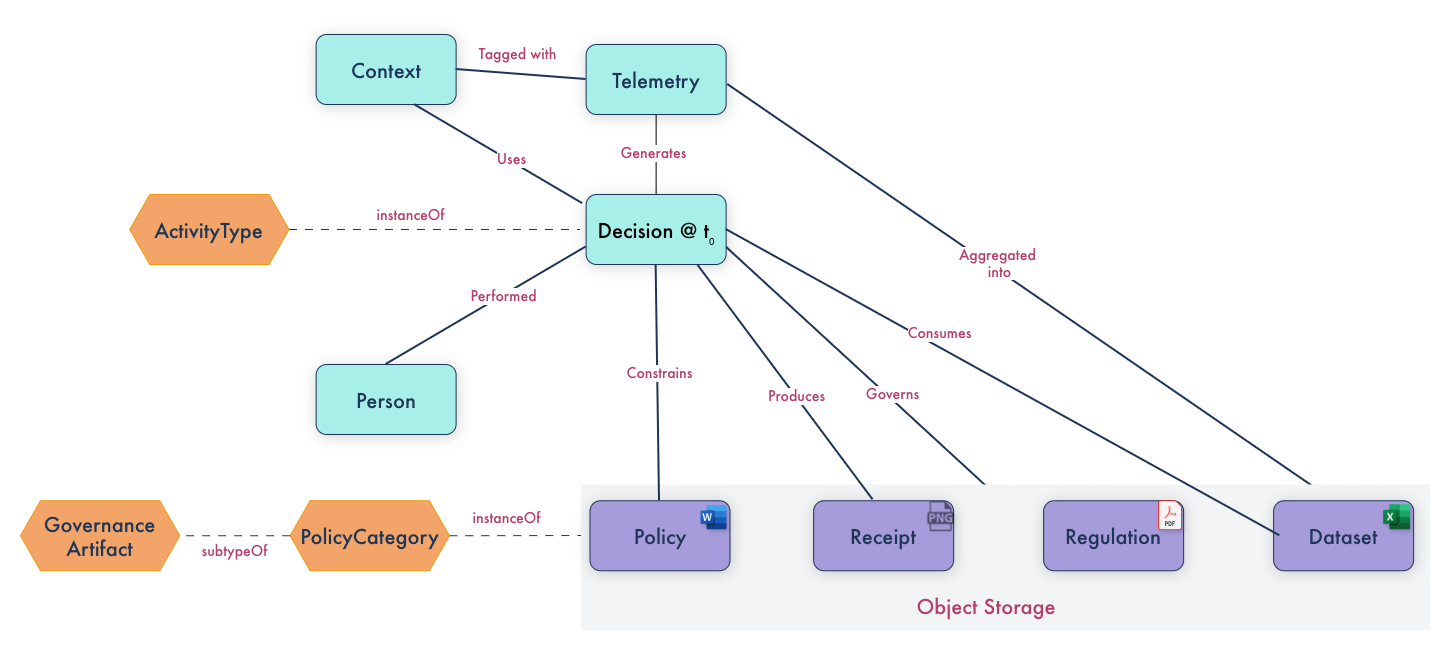
Reconstructing decision state at t₀ requires connecting models, data, context, and environment as a single, traversable whole.
A simple scenario
A model updates in the cloud.
Rare conditions emerge at the edge.
A decision leads to an unexpected outcome.
To understand it, you need:
- model version
- data and documents used
- local conditions
- interpretation of inputs
- intermediate steps
And you need them as a connected whole.
Without that: approximation.
With it: reconstruction.
The emerging requirement
The question is no longer:
How do we model our data?
It is:
How do we reconstruct our decisions?
Graphs remain foundational—but now as part of a broader requirement:
systems that capture, connect, and replay decision state.
Closing thought
The shift from data modeling to decision reconstruction reflects a broader move—from storing information to explaining outcomes.
Relationships still matter.
But the system that can explain what happened, when, and why becomes more than a database.
It becomes a system of record for decisions themselves.