
Drift Detection as Continuous Observation
Organizations rarely fail because of a single catastrophic event.
More often, problems emerge gradually. Policies stop being followed. Processes evolve without oversight. Documentation becomes outdated. Systems diverge from their intended configurations. AI models begin operating in environments that no longer resemble the conditions under which they were trained.
These changes often occur slowly enough to avoid immediate attention.
By the time an organization notices the consequences, the underlying drift may have been accumulating for months.
The challenge is not simply detecting that something has changed. The challenge is understanding what changed, when it changed, why it changed, and whether the change represents a meaningful risk.
Why Drift Is Difficult to Detect
Most systems are designed to describe the current state of the world.
They can answer questions such as:
What does the data look like today?
Which configuration is currently deployed?
What policy document is currently approved?
What relationships currently exist?
These questions are useful, but they do not explain how the current state emerged.
Without historical context, organizations often discover drift only after it produces an operational problem, compliance issue, financial loss, safety incident, or AI failure.
Effective drift detection requires more than observation of the present.
It requires temporal continuity.
The Importance of Temporal Continuity
Before drift can be detected, an organization must understand what existed previously.
This is where temporal reconstruction becomes important.
A system capable of reconstructing state at a specific point in time can answer questions such as:
What information was available when a decision was made?
What policies were active at that moment?
Which relationships existed between systems, assets, people, and processes?
What did the environment look like before a failure occurred?
These same capabilities provide the foundation for drift detection.
If an organization can reconstruct what was true at time t₀, it can compare that state against what is true now.
Drift becomes measurable.
How FlexVertex Approaches Drift Detection
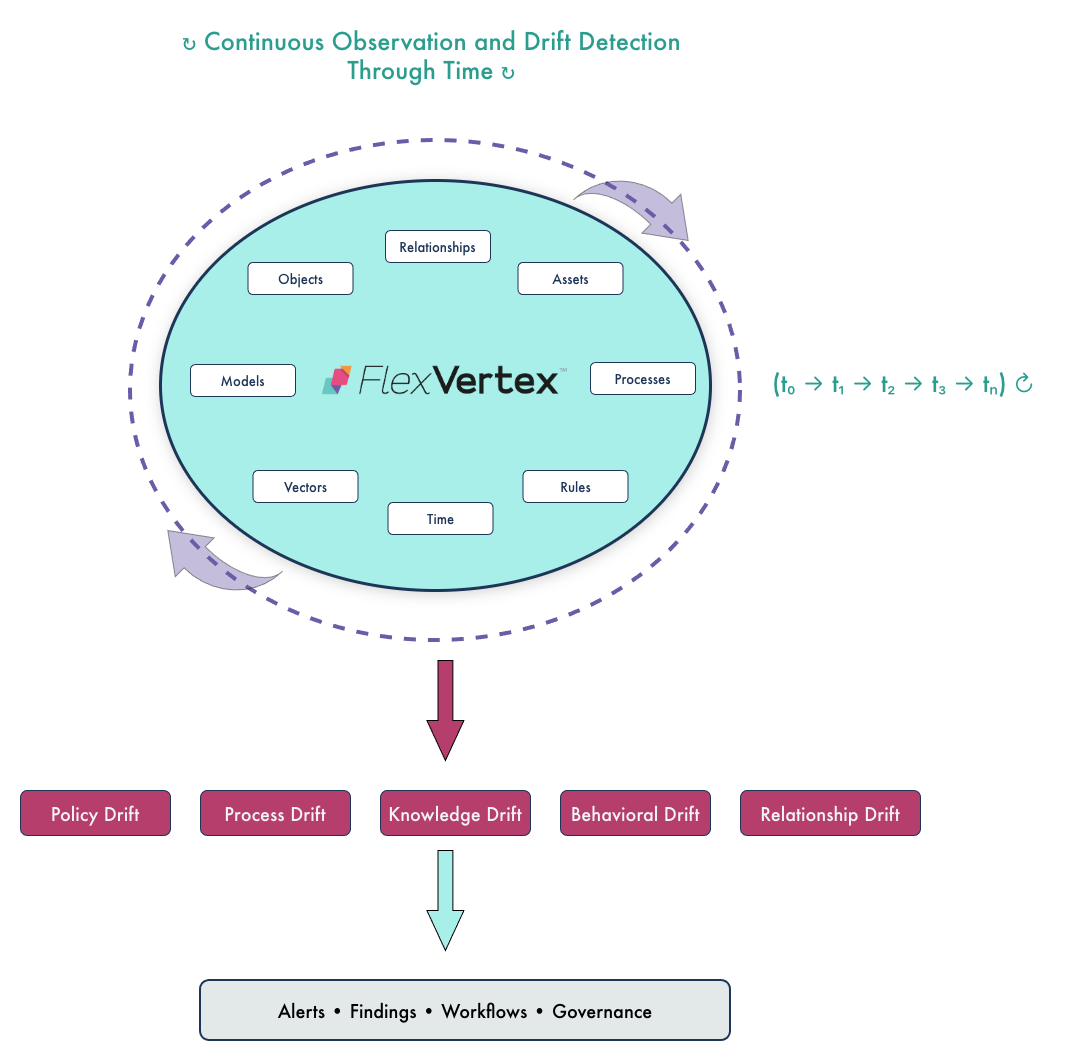
FlexVertex uses the same temporal foundations that support state reconstruction to enable continuous observation.
Objects, relationships, decisions, findings, assets, documents, and events can be preserved as they evolve over time. Relationships are maintained explicitly rather than being inferred after the fact. Historical context remains available for future analysis.
On top of this temporal substrate, organizations can define expectations using Voyager.
These expectations may describe policies, operational procedures, business rules, safety constraints, compliance requirements, or domain-specific conditions.
Examples might include:
Trips under 2,500 miles must use ground transportation.
Every invoice over a specified amount requires dual approval.
Autonomous vehicles must not exceed a defined operating boundary.
Critical systems must maintain approved configurations.
Customer onboarding workflows must include mandatory verification steps.
Once defined, these rules can be persisted alongside the data they govern.
As information enters the system, those expectations can be evaluated continuously.
The result is not merely historical analysis, but ongoing observation.
Types of Drift
Drift is not a single phenomenon. Organizations encounter many forms of divergence between expected and actual behavior. Here are a few examples:
Policy Drift. Documented policies continue to exist, but operational behavior gradually moves away from them. Employees may develop workarounds, informal practices, or alternative processes that no longer align with approved guidance.
Process Drift. Workflows evolve over time without corresponding updates to governance, controls, or documentation. The process being executed is no longer the process that was originally designed.
Knowledge Drift. Institutional knowledge, training materials, and documentation become disconnected from operational reality. People may continue learning from information that no longer accurately reflects how the organization functions.
Configuration Drift. Applications, infrastructure, and systems gradually diverge from approved configurations. Changes introduced through upgrades, emergency fixes, patches, or manual intervention can accumulate over time.
Data Drift. The characteristics of incoming data change. Formats, values, distributions, and quality may evolve in ways that affect reporting, analytics, operational processes, or AI systems.
Model Drift. AI and machine learning systems may become less effective as the environments in which they operate change. Assumptions that were valid during training may no longer reflect operational reality.
Behavioral Drift. People, teams, assets, or autonomous systems begin exhibiting patterns that differ from expected behavior. These deviations may indicate inefficiencies, emerging risks, or operational issues.
Relationship Drift. Dependencies and interactions between people, systems, assets, and processes evolve unexpectedly. Relationships that once existed may disappear, while new dependencies emerge without deliberate planning or oversight.
State Drift and Trajectory Drift
Not all drift is equally urgent.
Some forms of drift represent a current problem.
Others represent the early stages of a future problem.
A policy violation that has already occurred is an example of state drift.
An increasing trend toward policy violations over several months may represent trajectory drift.
Trajectory drift can be particularly valuable because it allows organizations to identify developing risks before they become incidents.
Rather than asking what went wrong, organizations can begin asking what appears to be moving in the wrong direction.
From Detection to Action
Drift detection becomes more valuable when it produces actionable outcomes.
Organizations may choose to:
Generate alerts when defined thresholds are exceeded
Create findings requiring investigation
Trigger workflows and remediation processes
Escalate emerging risks to responsible stakeholders
Maintain audit trails for governance and compliance purposes
Because rules are stored within the same substrate as the information they govern, organizations can evolve their detection capabilities over time without redesigning their underlying architecture.
New forms of drift can be identified simply by introducing new rules and observation strategies.
Beyond Compliance
Although drift detection is often associated with governance and compliance, the concept applies more broadly.
Physical AI systems can detect changing operational conditions.
Financial organizations can identify emerging patterns associated with risk.
Manufacturing environments can observe deviations from established procedures.
Knowledge-intensive organizations can monitor the health of their institutional memory.
In each case, the objective is the same:
Identify meaningful divergence before it produces undesirable outcomes.
Closing Thoughts
Drift rarely appears suddenly.
It emerges through a series of small changes that accumulate over time.
Organizations that can reconstruct historical state gain an important advantage because they possess the context necessary to recognize those changes.
By combining temporal continuity, connected knowledge, and persistent Voyager rules, FlexVertex enables organizations to move beyond simple monitoring and toward continuous observation.
The result is not merely the ability to understand what happened.
It is the ability to recognize when reality is beginning to diverge from expectation and to act before that divergence becomes an incident.