
The FlexVertex Sidecar: Building a Connected Knowledge Layer
Organizations rarely have the luxury of starting from a blank slate. Enterprise data already exists in operational databases, document repositories, object stores, ERP systems, AI applications, and custom software. Physical AI deployments face a similar challenge: telemetry, observations, decisions, images, and sensor data often originate in multiple independent systems.
Replacing these systems is expensive, risky, and frequently unnecessary.
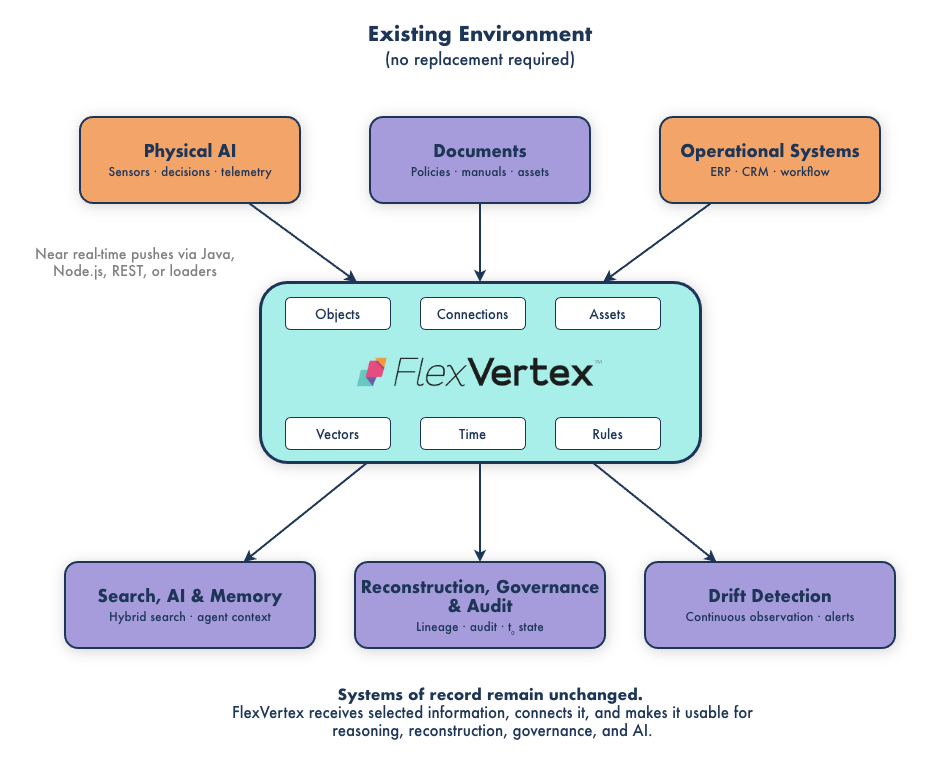
The FlexVertex sidecar pattern provides an alternative approach. Rather than replacing existing systems, a FlexVertex deployment operates alongside them, continuously receiving information and building a connected knowledge layer that can support search, reasoning, temporal reconstruction, drift detection, governance, and AI workloads.
A Physical AI Example
Consider an autonomous vehicle operating in the field.
The vehicle produces observations from cameras and sensors. Mission planning software generates tasks and objectives. Decision-making systems produce actions. Additional systems may record maintenance history, environmental conditions, operator interventions, and communications.
Each system performs its own function well, but the complete story is often fragmented.
A FlexVertex sidecar can receive information from these systems as events occur. Observations become objects. Decisions become objects. Images, telemetry, documents, and other artifacts can be stored directly or referenced through links to their systems of record. Relationships between these objects are captured explicitly.
Over time, the sidecar builds a continuously evolving knowledge graph representing not only what happened, but how events, decisions, assets, and outcomes relate to one another.
Months later, investigators may ask:
Why did the vehicle make a specific decision?
What information was available at that moment?
Which observations influenced the outcome?
Have similar conditions produced different decisions elsewhere?
The sidecar provides a foundation for answering those questions without requiring changes to the operational systems that generated the information.
What Is a FlexVertex Sidecar?
A FlexVertex sidecar is a full FlexVertex deployment operating alongside existing systems.
Depending on requirements, it may be deployed as:
Iron for individual systems and smaller environments
Platinum for clustered, highly available deployments requiring replication, redundancy, and workload distribution
Titanium in edge-oriented scenarios where local processing is desirable
The sidecar is not a limited integration component or lightweight cache. It is a complete FlexVertex environment capable of storing objects, documents, assets, vectors, relationships, temporal history, rules, and AI-derived knowledge.
Importantly, the sidecar does not require organizations to abandon existing investments. Systems of record remain where they are. Operational processes continue to function as before.
FlexVertex simply creates a connected layer that spans those systems.
How Information Enters the Sidecar
Information can be transmitted into a sidecar through several mechanisms, including:
Bulk loading processes
A common pattern is straightforward:
Create an object and its associated properties.
Receive the object's unique identifier.
Create additional objects.
Establish relationships between those objects.
Attach properties to both objects and relationships.
Because relationships are first-class citizens, important context can be captured directly on the connections themselves.
In many deployments, these updates occur continuously as information is generated by source systems.
What Happens Inside the Sidecar?
Once information arrives, the sidecar can do considerably more than store it.
Documents may be parsed, chunked, embedded, enriched, and connected to related information. Rules can be extracted from institutional knowledge and associated with relevant business entities. Objects can participate in graph traversals, hybrid search operations, AI workflows, and temporal analysis.
This processing occurs without requiring modifications to the originating systems.
As a result, organizations can introduce new capabilities incrementally rather than undertaking disruptive platform migrations.
Beyond Physical AI
The same pattern applies to traditional enterprise environments.
A document repository may contain policies and procedures. An ERP system may contain financial transactions. A CRM platform may contain customer interactions. Operational applications may contain workflow state and activity history.
A FlexVertex sidecar can receive selected information from these environments and establish connections that would otherwise remain hidden.
This creates opportunities for:
Unified search across previously disconnected systems
Institutional memory preservation
Cross-system reasoning
AI context enrichment
Governance and auditability
Drift detection and continuous observation
Because source systems remain intact, organizations can adopt these capabilities incrementally and at their own pace.
From Observation to Action
Many organizations begin by using a sidecar for observation.
They collect information, connect it, and make it searchable.
Over time, additional capabilities often emerge:
Detection of policy violations
Discovery of operational drift
Reconstruction of historical decisions
AI memory and context retention
Alert generation and workflow automation
The sidecar becomes a continuously evolving representation of organizational knowledge while remaining safely separated from the systems that generated that knowledge.
Closing Thoughts
The FlexVertex sidecar pattern allows organizations to create value without requiring large-scale replacement projects.
Existing systems continue performing their established roles. Systems of record remain authoritative. Information can remain in place, be selectively replicated, or simply be referenced.
Meanwhile, FlexVertex builds a connected, searchable, temporally aware knowledge layer capable of supporting AI, governance, investigation, operational intelligence, and future initiatives.
For many organizations, this approach provides a lower-cost, lower-risk path to knowledge unification than attempting to redesign the enterprise from scratch.